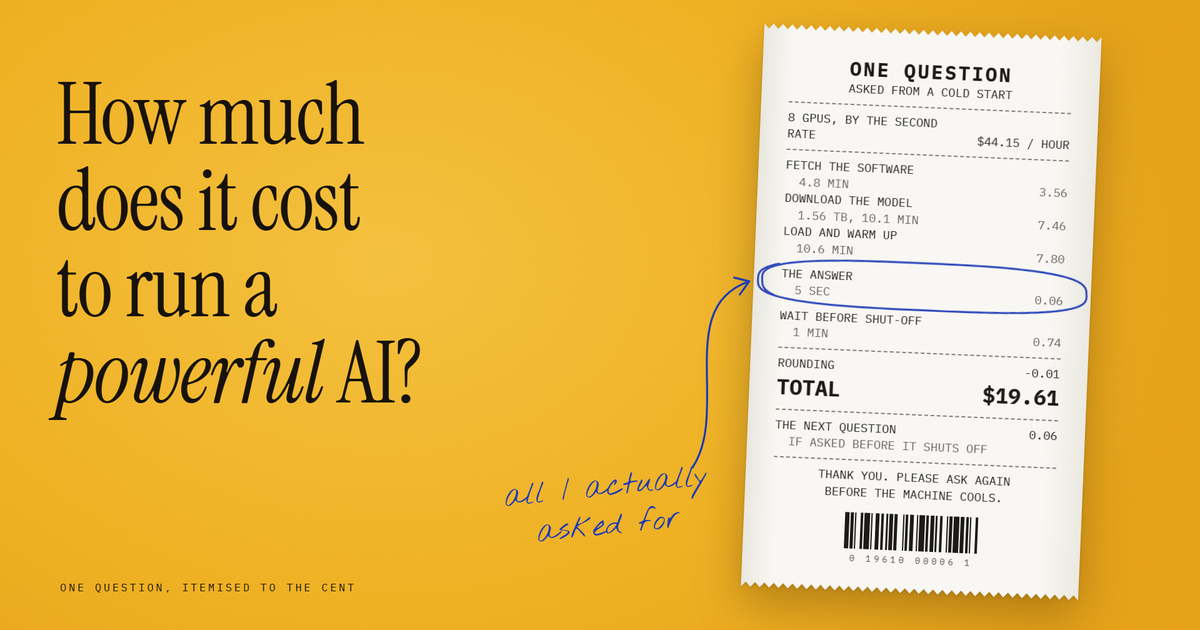
I wanted a straight answer, so I priced it out. Take one of the largest AI models anyone can download, rent the hardware it needs, and switch it on only when there is work to do.
The answer is four numbers. About $44 an hour on paper. About $70 for a real hour of work. About $20 to ask a single question from a standing start. And 6 cents for every question after that.
The model
Kimi K3.1 Pro is an open-weight model, which means anyone can download it and run it on their own hardware. It has 2.8 trillion parameters, and its files add up to 1.56 terabytes even after compression.
That size decides everything else. No single graphics card can hold it. It needs eight top-end cards working together in one machine.
The sticker price
On the two services I tested, eight cards rent for $44 to $72 an hour, depending on the chip and the provider. The cheapest setup I could cost out is eight AMD MI350X cards on RunPod, at $44.15 an hour. Eight NVIDIA B300 cards cost $58.06 an hour on Modal and $72.15 on RunPod.
Both services bill by the second and shut the machine off when it goes idle. On paper, you pay only for what you use.
In practice, the hourly rate is only where the bill starts.
What an hour really costs
Before the model can answer anything, the machine has to fetch its software, download 1.56 TB of files and load them into memory. On the cheapest setup that takes about 26 minutes, and the meter runs the whole time.
So an hour of real use looks like this:
- Start-up: $18.82
- The hour itself: $44.15
- Ten idle minutes before it shuts off: $7.36
That comes to about $70, not $44.
The shorter the job, the worse it gets. A 15-minute job works out to $149 per hour of use. An 8-hour job comes down to $47, close to the sticker price.
What one question costs
This is the number that surprised me.
Take one substantial question: about 8,000 tokens in and 1,000 out, roughly a long report in and a page or so back. Asked from a cold start, it costs $19.61.
The answer itself takes about five seconds of computing and costs 6 cents. The other $19.55 pays for the machine to get ready and wind down.
Ask a second question while it is still running and that one costs 6 cents. Run sixteen at once and each costs about 2 cents.
For comparison, the same question through the API of Moonshot, the company that makes the model, costs about 3 cents, with no start-up at all.
Three setups, side by side
The same four numbers for each setup I could cost out:
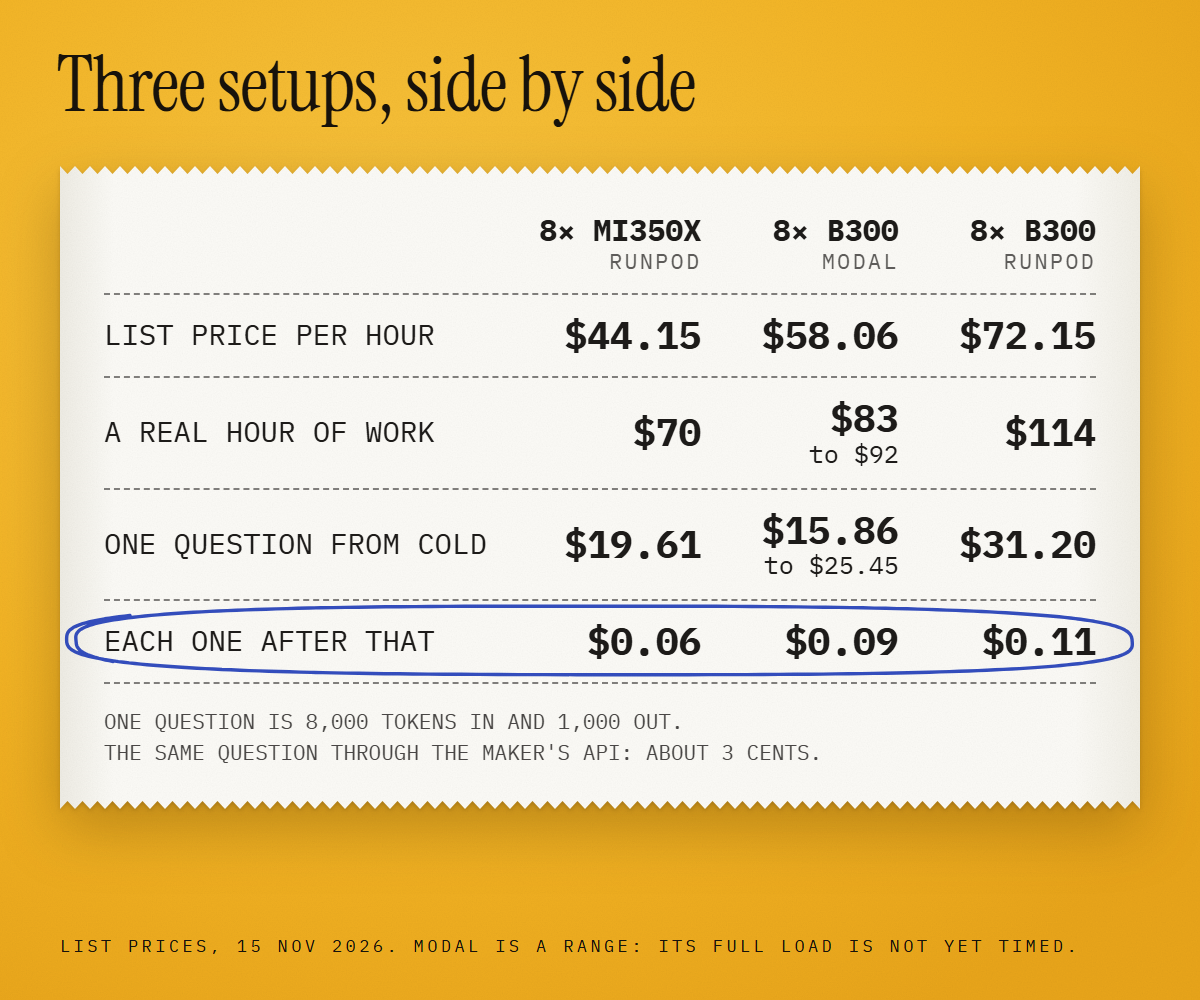
Modal's figures are ranges because its full load has not been timed end to end. It can beat RunPod on a single cold question because the model stays parked in its storage, for about $1.30 a day, so there is nothing to download.
Ten setups, ranked two ways
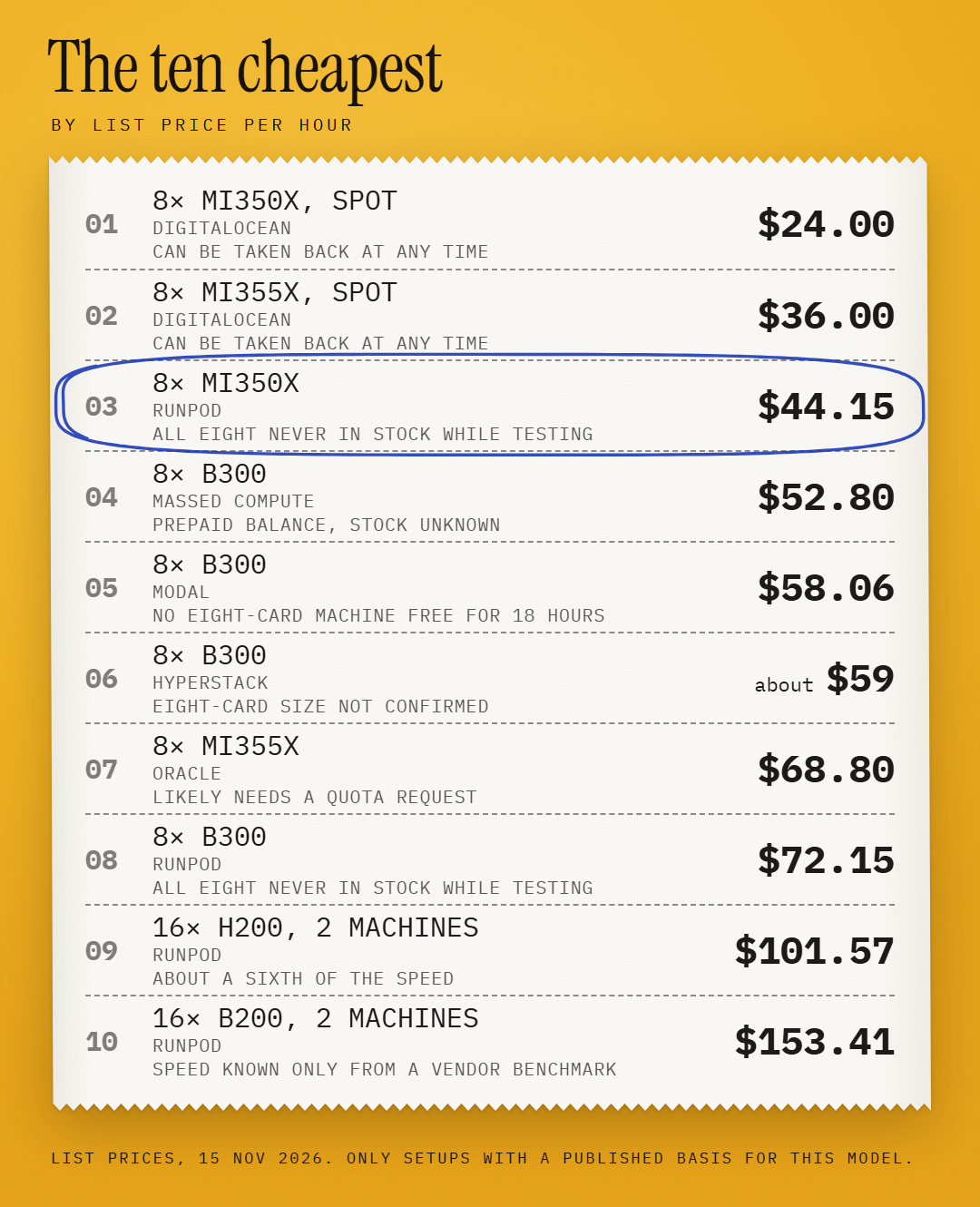
I found ten setups with a published basis for running this model. Here they are ranked by the price on the page, and then by what a one-hour job would really cost.
The ten cheapest, by list price per hour:
The ten best value, by the cost of a one-hour job:
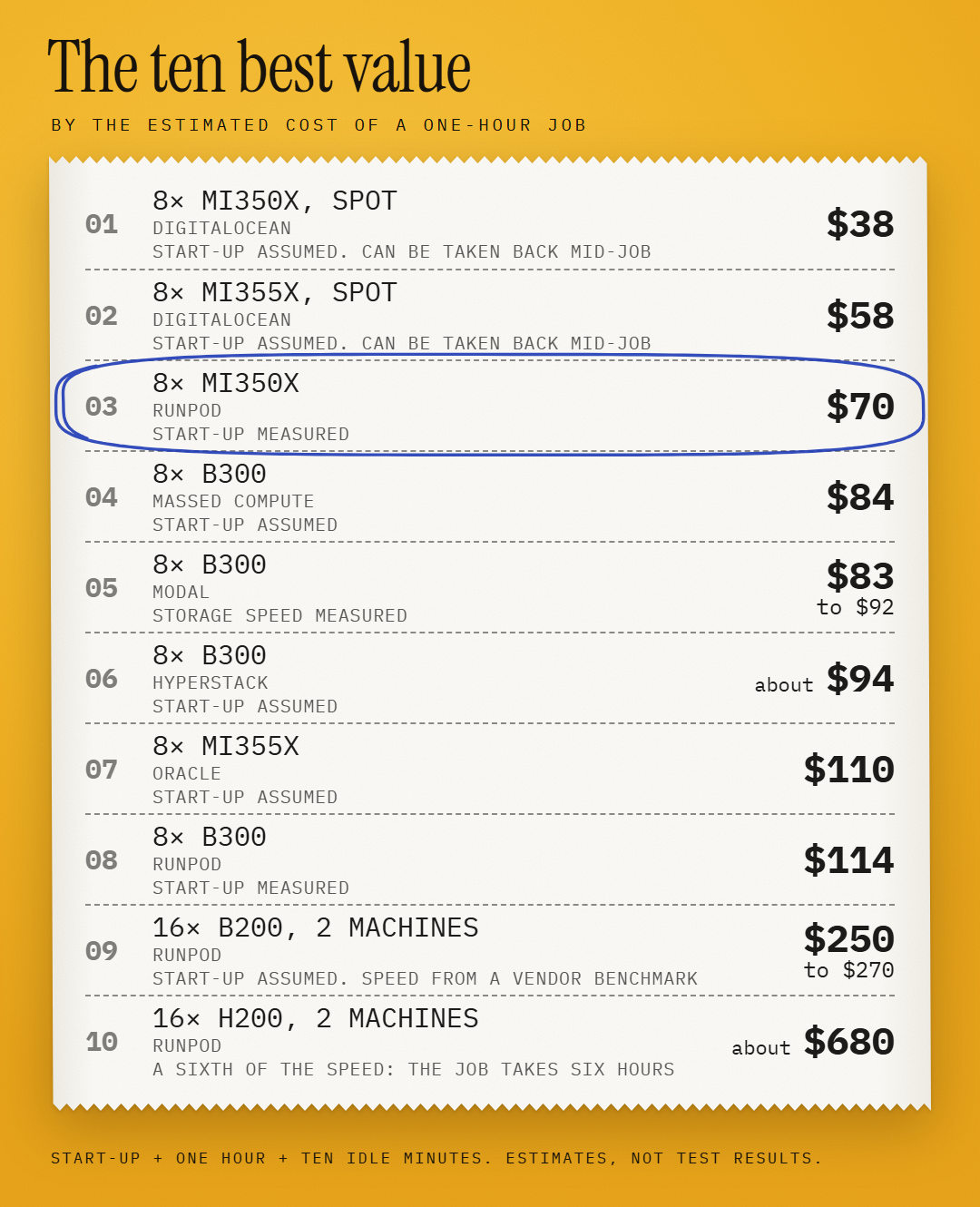
A one-hour job means the start-up, one hour of use and ten idle minutes before shut-off. Start-up is measured on RunPod and Modal; for the rest I assumed the 26 minutes I measured on RunPod. These are estimates from list prices, not test results, and layouts that nobody has shown running this model are left out.
The part money doesn't fix
You also have to get the machine.
On RunPod, all eight cards were never free at the same time while I was testing. On Modal, eight cards arrived within 33 seconds on eight separate tries, and then stopped arriving at all. At the time of writing, my full test has been waiting in the queue for more than 18 hours. Waiting costs nothing, but it answers nothing either.
Six cards still start within seconds. Eight do not, and eight is what the published setups for this model use.
What I take from this
- The cost of a big model is mostly the cost of starting it. Group the work into long sessions. One question at a time is the most expensive way to use it.
- For occasional questions, the API wins by a wide margin. Three cents against twenty dollars is not close.
- Running it yourself starts to make sense when the machine stays busy for hours, or when you have a requirement an API cannot meet, such as keeping data on hardware you control.
- Availability is the real constraint. A price only matters if the machine exists when you need it.
What I measured, and what I did not
I have not run the full model yet. The eight-card machine has not been available, so the model's speed here comes from figures published by the teams behind the serving software, vLLM and SGLang. The load time comes from a published benchmark of the previous model of the same size.
What I measured myself, in about twenty small tests costing under $6 in total: download speeds, software start-up times, usable memory per card, and how quickly an idle machine shuts off.
Prices are list prices from 15 November 2026 and will change. I also found lower list prices elsewhere, as low as $24 an hour for capacity that can be taken back at any moment, but I had nothing measured to cost them properly.
If you have run a model this size yourself, I would like to compare numbers.
Also published on LinkedIn and X, November 2026. Prices are list prices from November 15, 2026.